
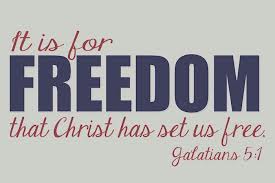
In the sermon on Sunday (6/30), I lifted up the similarities between civic freedom and our freedom in Christ. We are citizens of the United States and live with a great deal of freedom, but there are boundaries on our freedom so that my freedom doesn’t result in injustice for you. As Christians, we are also citizens of the Kingdom of God. We are free. Freedom isn’t just a state that, once we attain freedom, we get to bask in it and continue to enjoy freedom’s benefits for the rest of our lives. Freedom is a continual way of life in which we ask: “What are we freed from, and what are we freed for?”
This Week
As you read the Scriptures from Galatians this week, it is helpful to keep in mind that Paul established churches on each of his “missionary journeys”. Paul’s letter to the Galatians may have been written from Corinth in about 55 A.D. As Paul established churches and moved on to establish more churches, a group referred to as the “Judaizers” came along behind Paul and tried to convince the people that Paul’s message was flawed – that, in fact, the people had to be converted to Judaism (meaning: observe the dietary laws and be circumcised) in order to become Christian. As you can imagine, this was very confusing to the new believers. You can hear Paul’s concern for the people of Galatia in the readings below.
Reflect on what freedom (civic and faith) means to you, and what our society and our faith would look like if we suddenly didn’t have freedom?
What are you freed from?
What are you freed for?
- Monday: Galatians: 5:1, 13-25
- Tuesday: Galatians 4:1-11
- Wednesday: Galatians 4:12-16
- Thursday: Galatians 4:17-5:1
- Friday: Galatians 5:2-12
- Saturday: Galatians 5:13-26

Prayer
In your prayers this week, give thanks for the people who have fought and those who continue to fight for freedom and those who help to maintain the good order of our communities.
References
- Luther, Martin, “The Freedom of a Christian” (also known as “On Christian Liberty”). Perhaps the most notable quote from this treatise is “A Christian is a perfectly free lord of all, subject to none. A Christian is a perfectly dutiful servant of all, subject of all, subject to all.”
- Buechner, Frederick, “The Faces of Jesus” speaks of freedom and good works: “But if good works are not the cause of salvation, they are nonetheless the mark and effect of it. If the forgiven man does not become forgiving, the loved man loving, then he is only deceiving himself. ‘You shall know them by their fruits,’ Jesus says.”

 Epicurious Lutheran
Leave a comment