
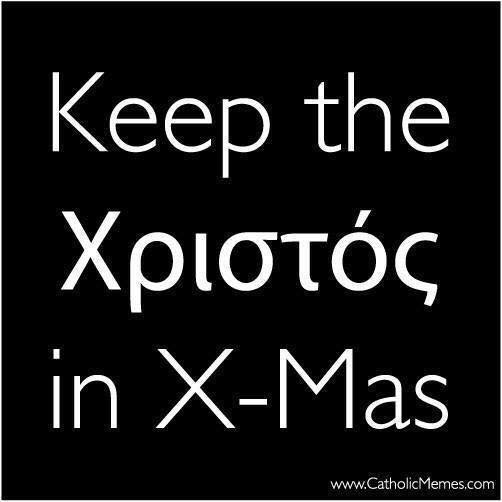
Every year at this time is the great debate about Christ-mas versus X-mas. The concern is that, by replacing “Christ” with “X”, we are “taking the Christ out of Christmas.” That would be true if the “X” was like the x in algebra where the letter is just a variable that stands in for or replaces the real thing. The reality is that X-mas is nothing new. As you can see in the etymology of X-mas below, X is the first letter of Christ in Greek. So, using X-mas is not being unfaithful or taking Christ out of Christmas. Besides, there’s really nothing we can do to take Christ out of Christmas as the birth of Jesus is an event of history. Some people choose not to observe Christmas. Whether we use the word Christmas or X-mas will not make a difference to them. Whether Christians call it Christmas, X-mas, or tomato doesn’t affect our celebration of it or the awe and wonder that “though he was in the form of God, did not regard equality with God as something to be exploited, but emptied himself, taking the form of a slave, being born in human likeness” (Philippians 2:6-7).
Shakespeare wrote: “What’s in a name? That which we call a rose by any other name would smell as sweet.”
So, whatever you call it, celebrate Jesus’ birth, and live the difference that His life, death, and resurrection makes in your life.
Merry X-mas!
| Xmas (n.) Look up Xmas at Dictionary.com”Christmas,” 1551, X’temmas, wherein the X is an abbreviation for Christ in Christmas, English letter X being identical in form (but not sound signification) to Greek chi, the first letter of Greek Christos “Christ” (see Christ). The earlier way to abbreviate the word in English was Xp- or Xr- (corresponding to the “Chr-” in Greek Χριστος), and the form Xres mæsse for “Christmas” appears in the “Anglo-Saxon Chronicle” (c. 1100). [source] |


 Epicurious Lutheran
Leave a comment