
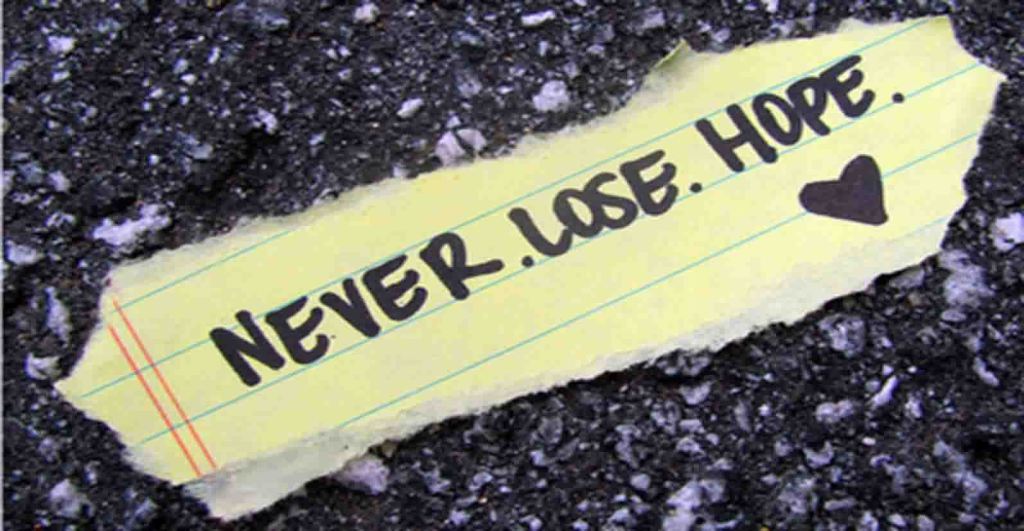
Therefore, since we are justified by faith, we have peace with God through our Lord Jesus Christ, through whom we have obtained access to this grace in which we stand; and we boast in our hope of sharing the glory of God. And not only that, but we also boast in our sufferings, knowing that suffering produces endurance, and endurance produces character, and character produces hope, and hope does not disappoint us, because God’s love has been poured into our hearts through the Holy Spirit that has been given to us.
~ Romans 5:1-5
I get to have a lot of great conversations with people. One of the frequent themes has to do with hope. If someone were to ask: “How do you define hope?” How would you answer?
If you think back to the times you have talked about hope in the past year, I’m guessing you’ll come up with sentences like: “I sure hope things get better for you.” “I hope I do well on that test.” “I hope I can get a better job.”
Are these examples the same kind of hope that St. Paul writes about in Romans 5? I think a lot of our casual uses of the word “hope” are actually used in place of “dream” or “wish.” When we speak of “hope” in this way, it makes hope seem much more weak, flimsy, and, frankly, not very hopeful. I think it actually takes away from real hope in the same way as using “love” for everything from tacos to the most significant relationships in our lives diminishes our use of the word love.
Hope the way St. Paul uses it is surprising. Hope actually arises out of suffering! If you think about it, it makes sense. How many of us have to be hopeful … I mean really hopeful … when things are going great. When we suffer, we quickly find out how not in control we are and often how powerless we are. So we are left with hope. But hope begs us to ask the question: “Hope in what?” Hope in ourselves? Well … we’ve already determined how out of control and powerless we can be. Hope in karma? What is karma anyway other than a concept of cosmic cause and effect espoused by Hindus and Buddhists? Hope in money? Hope in friends or family? Hope in … God?
As Christians, I know we feel that our answer really should be God, right? But most of us find it hard to trust in God because to trust in God is to know what God is saying to us or asking from us. That’s part of the problem. Look at hope from the standpoint of leadership in our church? We are talking now about what God is calling us to do at Bethel and what that means for a building, for staffing, and for involving people in the various ministries. We can see that there is not enough money or people or leadership or time – this is a position of scarcity. We can look at these same situations where there is not enough and apply the “hope that does not disappoint us” and expect that we will have what we need – this is a position of abundance. God isn’t calling us to do everything and be everything for everyone … that’s where discernment comes in. The question for us is: Do we hope that God will provide all that we need to accomplish what He’s calling us to do?
This is what I think hope is: I think hope is not just a state of being, a mindset, and certainly not merely a wish. Hope is a process. It is a process of watching and listening for God. A process of talking with others and discerning together what we believe God is calling us to. Hope is trusting that there is no cap to God’s provision – God’ provides abundantly for us to do His work. A critical piece of hope is then taking steps toward God. It may be that we end up going the wrong direction, but, if we do, we do it together. A friend when I was growing up used to say “God can’t direct your steps when you’re standing still.”
I pray that we continue to grow as people of hope who come together to hear God’s words for us then joyfully and confidently take steps in faith.
In Christ,
Pastor Jeff

 Epicurious Lutheran
Leave a comment