
For now we see in a mirror, dimly, but then we will see face to face. Now I know only in part; then I will know fully, even as I have been fully known. And now faith, hope, and love abide, these three; and the greatest of these is love.
~ 1 Corinthians 13:12-13
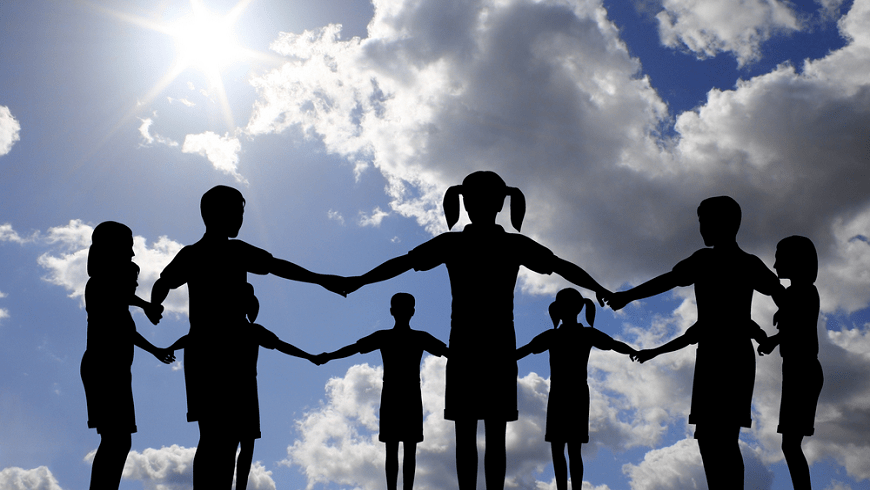
Humans are meant to be in community – in relationship with one another. Some people may protest and say that they are independent and self-sufficient and that they don’t want to rely on anyone else. Yes, some of us are introverts and others are extroverts with differing social needs, but we all need to relate. We all need to know that we matter to someone else, and, frankly, that others matter to us.
I heard a speaker a few years ago that said something like this: “Isn’t it funny that in an age of social media and instantaneous worldwide connectivity that we still feel socially starved?” I’m not here to say that we should throw away all of our technology, but that genuine connectedness is vital as it draws us further into community.
This is my first is a series of three articles that focus on community – what it is, why we need it, where it breaks down, and how we can be an active part in building a stronger community. Especially as I write about the Church, I will use the image of the Body of Christ that Paul writes about in Romans 12 and 1 Corinthians 12.
Here are a few questions for you, the reader, to answer for yourself:
- How many communities are you part of? For example, I part of my immediate family, various communities of friends, the congregation. I am also part of Manassas, Virginia, the United States.
- Why are you part of each of these communities?
- Do any of these communities feed and nurture you?
- Do you help to feed and nurture others in any of these communities?
Depending on the specific community, you may feel that you have a lot of influence or very little. You may feel valued and central, or you may feel anonymous and unimportant. You may have heard of the butterfly effect that says: a butterfly flaps its wings in Brazil and sets off a tornado in Texas. This is the concept that something unknown and anonymous can have a profound and unpredictable effect. So, the idea of being completely isolated or completely independent of others is fundamentally impossible and certainly not good or healthy for people. If we try to cut ourselves off or isolate ourselves, we miss out on opportunities to love and be loved, to serve and be served; we miss out on diversity of thought and experience. When we are cut off from community, we find ourselves in that situation of social starvation.
God created humanity to be in relationship with us, and Jesus prayed “that they may be one, as we are one” (John 17:22). Being part of community does not mean that we all agree or that we see or interpret things the same way. It means that, in spite of our differences (think about the body of Christ), we are still part of the same body.
Take a moment now to write down as many of your communities that you can think of. When you’re done, take a moment to pray for and give thanks for those communities.
In Christ,
Pastor Jeff

 Epicurious Lutheran
Leave a comment