
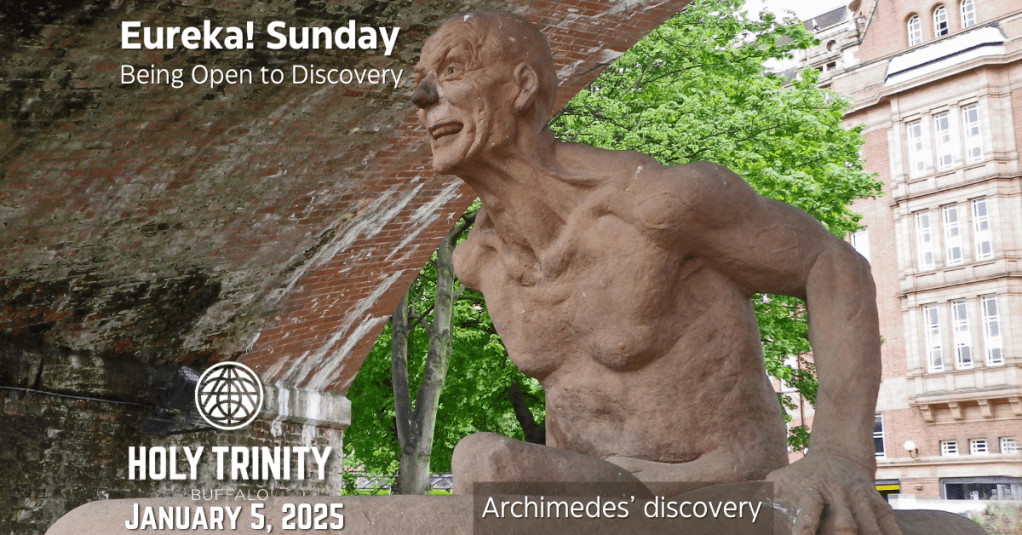
Sermon from the Epiphany of Our Lord – January 5, 2025, at Holy Trinity Lutheran Church – Buffalo, NY .
Sermon Video | 8:30am and 10:30am Worship Services
Sermon Text | Matthew 2:1-12
Grace to you and peace from God our Father and the Lord Jesus Christ. Amen!
Do you know the story of Archimedes? He was a 3rd century B.C. Greek mathematician. You might be interested in a quick internet search to read about his significant contributions mathematics, physics, engineering, and astronomy.
The story of one of his discoveries goes like this: the king gave a jeweler a gold bar and told him to make a gold crown out of it. When the jeweler had finished his work, he presented the crown to his king. The king became suspicious because of the color of the crown. So, he weighed it and found that it was the same weight as the gold bar. But this observation didn’t satisfy the king. He still thought something wasn’t right.
So, the king asked Archimedes to help him test the crown to see if he had been cheated by the jeweler. Archimedes pondered how one would be able to prove whether the crown was pure gold. Despite his learned expertise, his answer did not from typical study. Instead, he made a sudden and unexpected discovery came while taking a bath.
As Archimedes lowered himself into the bath, the level of the water rose. The amount the water level changed was related to the volume of his own body. With that … Archimedes leapt out of the bath with glee (but without clothing) and ran through the city shouting: “Eureka!” which means … “I’ve found it!”
Archimedes discovered that the crown, while it weighed the same, was actually larger than it should have been if it was truly made out of a gold bar. It displaced more water than it should have. Archimedes therefore reasoned that the jeweler had, in fact, cheated the king by replacing some of the gold with silver. So you could say that the jeweler was really in “hot water.” 😊
Did Archimedes “make” himself come to this discovery? Can anyone really “make” themselves discover? Discovery is actually something that happens TO you. We out ourselves in a position to discover by creating opportunities for inspiration by giving ourselves space, having curiosity, and … frankly … relaxing.
Today as we celebrate the Epiphany of Our Lord, we find ourselves in a place of discovery and curiosity.
At various points in our lives, we are faced with questions that really stump us. Even when we weigh the options, examine the pros and cons, and apply all sorts of logic, the path doesn’t seem clear. So, we look for illumination. We look for light … for guidance … to see our way forward. We look for … epiphany.
The “wise men” or … more accurately … the magi, were astrologers and scientists. They saw a configuration of stars that had particular meaning to them. Because we know the story from the Bible, we assume that “of course they would travel to see Jesus” … but there’s more to it than that.
The magi were in a situation not too unlike that of Archimedes. They had a question that they couldn’t immediately answer and they were curious enough to seek it out. What they saw aroused curiosity. Something in them wanted and even needed to know if what they were seeing in the stars was true. Their curiosity led them to load up and travel from the region of modern-day Iran to Jerusalem, which would have been about 1,300 miles. This is not a journey undertaken on a whim.
The way we typically tell the Christmas story, we may end up thinking that the magi visited Jesus around the same time as the shepherds, and that they visited Jesus while He was still in the barn laying in a manger.
Yet, the reading from Matthew tells us that Jesus is a “child” rather than a “baby” and that he was in a “house” rather than a “stable.” So, the magi probably saw Jesus between 40 days and 2 years after His birth – that’s why King Herod sent to kill all children 2 years old and younger (the event known as the massacre of the Holy Innocents).
There is so much that is important in this story, but sticking with the ideas of curiosity, discovery, and revelation, we are led to see not only WHAT God reveals, but WHO God reveals to. In this case, God spoke to people from a foreign land through the stars. This is a big deal because God not only spoke to the “chosen people” about Jesus, but also to people of other nations, languages, customs, and religions.
God welcomed the magi … and then trusted them with the life and safety of His son, the savior. They could have ignored the dream that warned them not to return to Herod. They could have told Herod precisely where they found Jesus. They didn’t have to protect this child.
Through God’s welcome, the magi came to a moment of discovery … of eureka! … of epiphany.
God doesn’t always move stars to get people’s attention, but you and I also face questions and opportunities throughout our lives.
A great way for us to live is with a posture of curiosity and wonder. We can’t “make” ourselves come to answers … revelation … epiphany as we engage our own questions about life or about God. However, with curiosity, wonder, and even a well-timed bath … we can discover and see for ourselves what God reveals to us.
Perhaps part of our epiphany is seeing for ourselves that God is in the process of discovering, too. God is seeking US out … knowing US … loving US totally, completely, unconditionally. God also is in a position or posture of discovery, curiosity, and wonder concerning you and me. God continues to reach out to and be in relationship with all people everywhere so that they might discover and know for themselves God’s wide and unconditional love for ALL people.
In the name of Jesus. Amen.
Photo Credit: A sculpture of Archimedes outside Manchester University in England. (CC BY 2.0)

 Epicurious Lutheran
Leave a comment