
July 19, 2026 | 8th Sunday after Pentecost
Holy Trinity Lutheran Church – Buffalo, NY
References
Scripture: Matthew 13:24–30, 36–43
Video of worship/sermon
Looking for Ourselves in the Parable
The parables of Jesus are short stories meant to teach a deeper, spiritual truth. They were challenging for the people who heard them directly from Jesus and they remain challenging for us even after 2,000 years.
In the parable of the weeds of the field in Matthew 13, Jesus uses the labels like “good” seed, “bad” seed, sower, reapers, slaves, enemy, and evildoers. No one reading or hearing this parable would want the negative labels to be applied to them – we would rather be the “good” seed than the “bad” … the “children of the kingdom” rather than the “children of the evil one.”
But focusing on these labels diverts our attention away from hearing and learning what Jesus has to say.
Many of us probably feel the pull to answer the question of whether we are weeds or wheat. If we are the wheat, then we are the “good” seed that was sown by Jesus. On the other hand, if we are the weeds, then we are the “bad” seed that was sown by the evil one that are ultimately gathered, bound, and thrown into the fire.
If we’re the wheat, it’s wonderful! If we’re the weeds, it’s terrifying.
But how do we know … for sure?
What if I’m a weed, but I really want to be wheat?
If I’m a weed, can I change? If so, how? Am I forever destined to be a weed and my future is to be thrown into the fire?
Where is the good news? Where is the hope?
Do you see what this does to us?
We either cling to our own “goodness” — whatever that means — to prove we’re wheat … or we find ourselves swimming in a pool of uncertainty and despair because we’re not good enough.
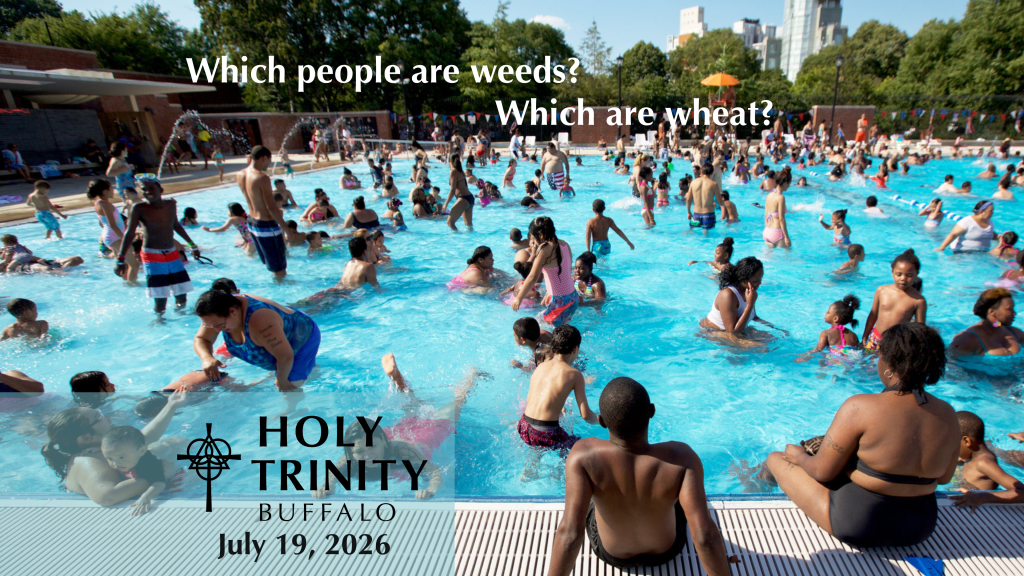
A Swimming Pool Full of Wheat … and Weeds?
Once while I was sitting at a swimming pool, I was enjoying the sounds of summer. You can probably hear those sounds in your mind: children laughing, people talking, water splashing, whistles blowing.
As I watched the children in the pool, I had a thought that took me off-guard: What if this pool was a field? And what if the children in the pool were weeds or wheat growing in that field?
Which of these children are wheat? Which are weeds?
Standing there looking at that pool full of children … I couldn’t tell.
Imagine if I determined that a child was a weed, but years later it became clear they were wheat? How might my labeling that child as a weed have affected how I treated them?
Our Identity Is Determined by God’s Promise
The beauty … the grace … the hope of this parable is that Jesus is very clear that we are not the sowers. We are not the angels who gather the harvest.
And this is where the Good News becomes clearer and corrects the lenses through which we see ourselves and the world.
We are God’s children—even though, at times, we may feel like wheat and at other times we may feel like weeds.
Our identity is not determined by people’s labels, biases, or judgment. Our identity is not determined by our worst moments and it’s not determined by our best moments.
Our identity is determined by God’s promise of love.
Notice what that means.
This isn’t about how “good” we are or how good we feel. Those are judgments rooted in ourselves and our own sense of worthiness. That way of thinking makes us the ones who decide whether we are good enough to belong to God … good enough to be wheat.
This parable frees us from trying to prove ourselves worthy of the label of “good seed” or to judge others and determine what kind of seed they are.
It is actually an invitation to live in the world as it is—not how we want it to be or prefer that it was … not some perfectly manicured field that is only and exclusively growing the good seed. That’s not real life anyway.
Living in a Divided World
In our time of politically divisive rhetoric, we are inundated with labels. We don’t have to search very long before we see labels similar to “good seed” being used of people who are of the same political persuasion as we are. We also see a prevalence of people labeled as “bad seed” for those who differ from us. The good seed is seen as the best side, right, and wise. The bad seed is viewed as evil, immoral, unethical, and wrong.
This invitation to live in the world as it is gives us some breathing room. Regardless of how we feel about ourselves and others, our call is to live in the field as wheat—wheat that grows and produces fruit.
There really is no benefit to anyone if we focus on anything else.
This is not a message of complacency that encourages us to stay exactly the same. Instead, it is an invitation to live as wheat so that it becomes evident who and what we are.
Unfortunately, there are Christians whose lives look more like weeds than wheat.
Bearing Fruit for Our Neighbor
Living like wheat means that we grow, bear fruit, choose compassion instead of condemnation, welcome the stranger, care for the sick and poor, love the unlovable, and offer hope when cynicism would be easier.
Living like wheat means recognizing our own biases and consciously setting them aside to be deeply present with the actual person in front of us—not worrying about who is wheat and who is weed—but seeing them as beloved children of God, too.
We don’t live as wheat to try to prove anything to God by showing God how good we are or display all the good we can do.
Martin Luther reminded us that “God doesn’t need your good works. Your neighbor does.”
Reflection Questions
- When have you found yourself trying to decide who is “wheat” and who is “weed”—including yourself?
- How does remembering that your identity is determined by God’s promise of love change the way you see yourself?
- What might it look like this week to “live as wheat” by bearing fruit for your neighbor?

 Epicurious Lutheran
Leave a comment