
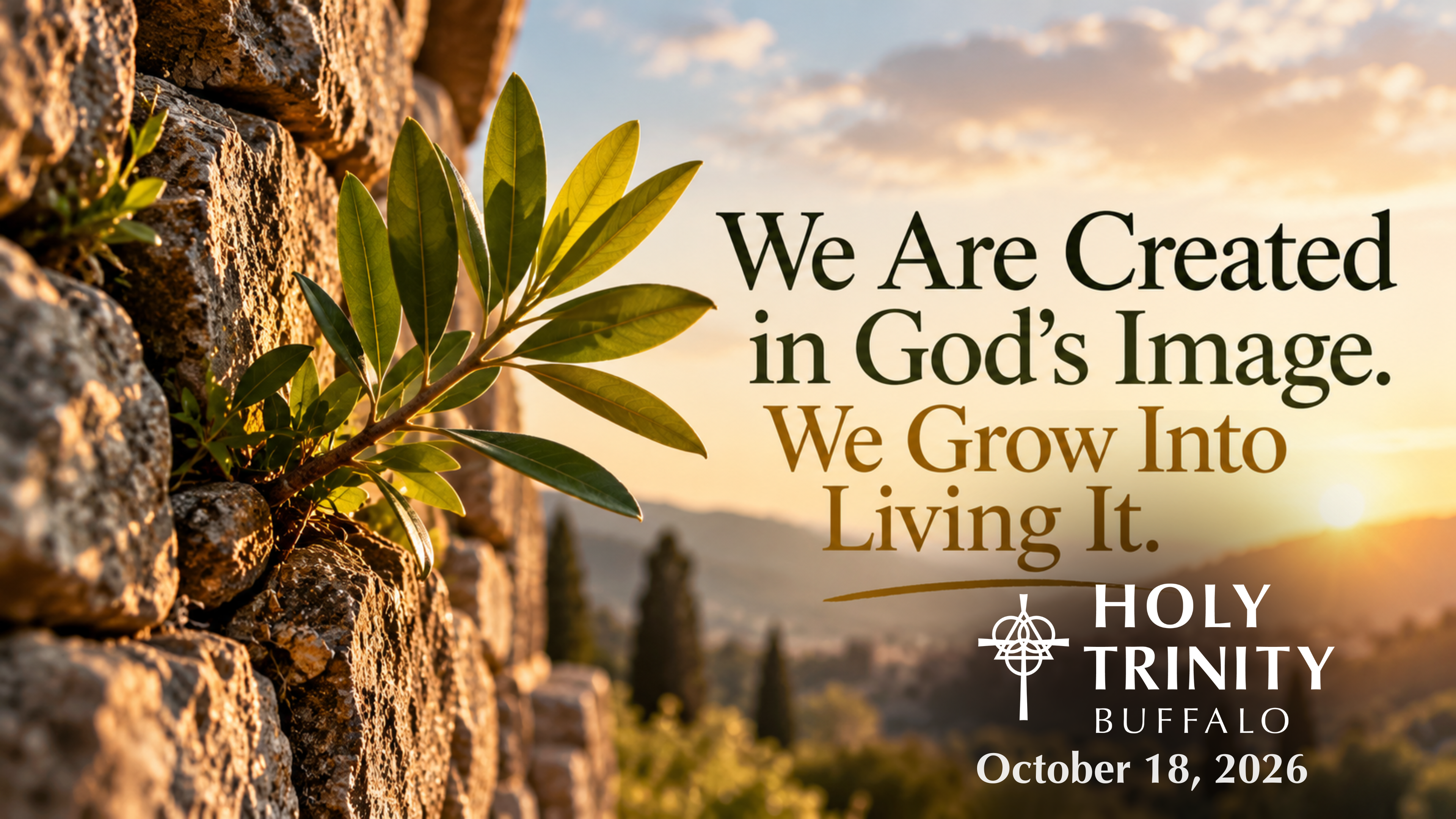
October 18, 2026 | 21st Sunday after Pentecost
Holy Trinity Lutheran Church — Buffalo, NY
References
Scripture: Matthew 22:15-22; Genesis 1:26-27
Video of worship/sermon
When Religion, Politics, and Money Collide
As you may recall from the last few weeks, Jesus had been teaching and telling parables in the temple in Jerusalem. The Pharisees, scribes, and other religious leaders were listening. They knew that much of what Jesus was saying was directed toward them.
They felt threatened … angry.
So, they come up with a question they believe would surely get Jesus in trouble. A question that would force him to align himself either politically with the Herodians or religiously with the Pharisees.
They asked Jesus: “Is it lawful to pay taxes to the emperor or not?”
A simple question and it should be easy to answer.
Together, the Pharisees and Herodians were trying to entrap Jesus in that really murky place where religion, politics, and money intersect. Not a great place to be!
Whose Image Is on the Coin?
They brought a coin to Jesus, a denarius, which is a Roman coin bearing the image of Caesar.
Jesus asked them: “Whose head is this, and whose title?”
Now, translating that word as head is fine, but I think it misses something important. The Greek word is image or likeness.
Whose image? Whose likeness is on this coin?
And just because the image on that coin is Caesar’s, does that mean the money really belongs to him?
Well, we might say yes. But what happens to that coin when Caesar dies? What happens to his vast military? What happens to the power he has amassed? What happens to all his treasure?
He can’t take it with him.
All those things pass on to a successor.
So, is that power really his? Is that money really his?
The thing is, political leaders come and go. Governments rise and fall. Nations and empires change.
No political leader, no government, no nation, and no empire is sacred. None is holy. None is eternal. None is God.
Do we worship a country? A political leader? A government of any sort?
Of course, we do not.
I don’t think this question is merely about paying taxes. It’s not merely about money, politics, or religion.
I wonder if Jesus is asking us a much deeper question.
Whose image do you and I bear?
What inspires us? What motivates us? What changes us? What challenges us?
What image are we living into?
Created in God’s Image
In Genesis, the first book of the Bible, we hear that humanity is created in God’s image.
And we know that doesn’t mean God’s physical image, right?
All of humanity is created in the image of God.
And, if we are made in God’s image, then the things that matter to God matter to us.
What God loves, and who God loves, is who we love.
Who God serves is who we serve.
Who God welcomes is who we welcome.
And notice something important here.
This isn’t just about the people sitting in our churches. It isn’t just about people who subscribe to a particular philosophy or religion.
All of humanity is created in God’s image.
But I’d also suggest that bearing God’s image isn’t simply a one-and-done thing. It’s something we grow into.
We grow in our understanding of what that image means. We grow in our ability to reflect God’s love. We grow into the image of Christ within us.
And if all of humanity is created in God’s image, then shouldn’t we begin to see our neighbors as bearing God’s image, too?
Doesn’t that change how we interact with people?
Doesn’t that change how we understand their dignity, their worth, and their place in our communities?
What happens when we look at another person, especially someone with whom we disagree, and recognize that they, too, bear the image of God?
Seeing the People Jesus Sees
You see, more than politics or religion or money, Jesus values people.
Jesus cares about people.
Jesus wants to restore and reconcile people.
Jesus is concerned about the woman at the well.
Jesus is concerned about the man born blind.
Jesus loves his disciples, even Judas Iscariot, the one who would betray him.
Jesus is concerned about those wandering like sheep without a shepherd.
Jesus is concerned about the sick, the grieving, the lonely, the frightened, and the forgotten.
Jesus is interested in the whole person.
Their whole lives.
Their dignity.
Their relationships.
Their place in society and in community.
Their experience of God’s love.
And sometimes, living into the image of God means that we challenge the systems, decisions, and even governments that fail to recognize that dignity.
Not because we’re trying to push our own philosophy or religion onto other people. Not because we’re trying to force people to become Christians or to believe what we believe.
But because when you and I speak up on behalf of those who have been cast aside, we are busy living into the image of God that we bear.
We are reflecting the love of Christ.
We are recognizing the image of God in our neighbors.
And that calls us to love our neighbors … all of them.
ll of them.
Living Into the Image We Bear
You know as well as I do that the news is filled with examples of people behaving badly. We see images of power being used to divide people, diminish people, and push people aside.
But those are not the images and likenesses that you and I are called to live into.
We are called to live into the image of Jesus.
The Jesus who loves the stranger.
Who welcomes the outcast.
Who heals and brings wholeness to people.
Who restores relationships.
Who reminds people of their dignity and worth.
These are the matters that concern God.
And these are the matters that should concern us.
How we live those values through our politics, through our money, through our religion, and through our everyday relationships matters.
Because the question Jesus asks isn’t simply about whose image is stamped on a coin. It’s about whose image is reflected in our lives.
Whose image do you bear?
And perhaps an even more challenging question: Whose image do others see in the way you live?
You and I are called to grow into the image of Christ, to love the people he loves, and to serve the people he serves.
In the name of Jesus. Amen.
Questions for Reflection
- Whose image am I living into? What voices, values, or sources of power most influence my decisions, priorities, and relationships?
- How does recognizing God’s image in every person change the way I see my neighbors? Particularly those with whom I disagree or whose experiences are different from my own?
- Where might God be calling me to act? Are there people whose dignity is being overlooked or diminished, and how might I reflect Christ’s love by standing with them?

Leave a Reply