
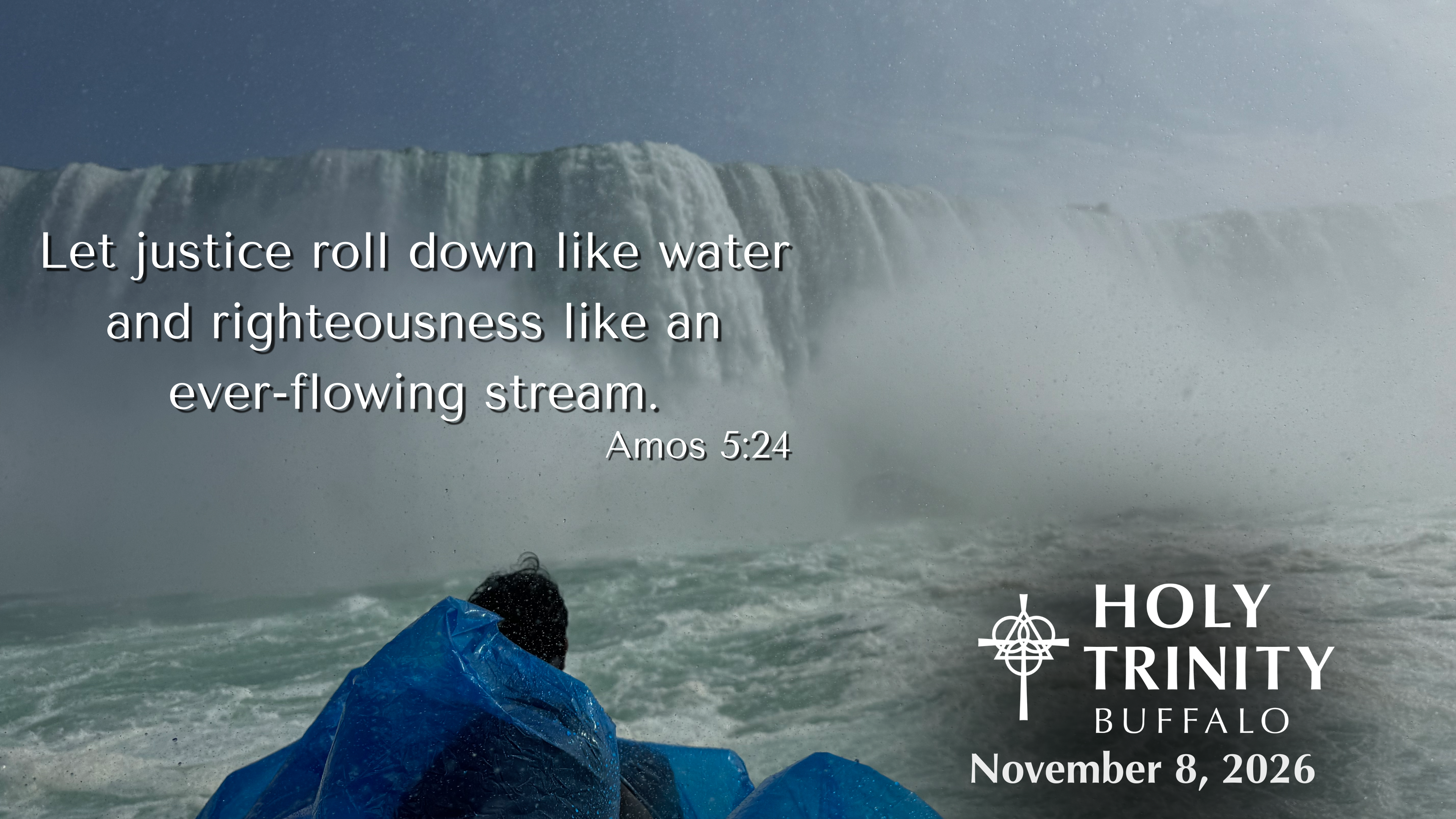
November 8, 2026 | 21th Sunday after Pentecost
Holy Trinity Lutheran Church — Buffalo, NY
References
Scripture: Matthew 25:1–13; Amos 5:24; 1 Corinthians 13:13
Video of worship/sermon
Waiting Is Not the Point
I was out of town for the past two weeks. One of those weeks, I was really suffering. It was just terrible.
I was in Maui for my nephew’s wedding!
Let me tell you … what a gorgeous place. And you all know me. I like food, and there was some really good food there, too. I’ve got more pictures than anybody really wants to see, but you’re welcome to see them!
Then, last week, I was at a dear friend’s ordination. She had been the Director of Youth and Family Ministries at my last congregation. She went to seminary, graduated, and was called to serve a congregation in Virginia.
What a joy it is to be with someone who has so thoughtfully engaged the prayerful process of discernment and made that commitment to serve the Church.
The Waiting That Prepares Us
The thing is, people getting married or people becoming a pastor don’t just get up one day and say, “I think I’ll become a pastor!” Or, “You know what? I think I want to get married!”
Usually, you meet somebody, and then there’s a process. There’s some discernment. There are experiences that happen along the way.
The same is true with ordination. You don’t just decide to become a pastor one day.
That brings me to the parable of the wise and foolish bridesmaids.
They were there for a purpose. They didn’t just wake up one day and say, “I’m going to be a bridesmaid!” They had been asked to do this.
The five wise bridesmaids in the parable didn’t just go with the flow. They had prepared. They not only had the oil they needed for their lamps, they had extra.
But the five foolish bridesmaids only had enough oil to keep their lamps lit for a shirt time. They didn’t prepare by having extra oil.
You see, there’s a period of waiting, but there’s also a choice. Are we going to be passive in our waiting, or are we going to be active in our waiting?
The five wise bridesmaids were active in their waiting. They had prepared for what was coming.
Waiting Is Not the Point
All this talk about waiting made me think about the ways that you and I wait. I went to the new Costco the other night. Speaking of waiting!
The hope that helps us continue to wait and that motivates us, is the confidence that there’s going to be something worthwhile at the end of the wait. In the case of CostCo, one of the long lines was for people signing up for a CostCo membership.
Sometimes is seems that all we do is wait, including that many of us were waiting for the election to be over!
There is a member of our staff who said, “You know, I voted early. Shouldn’t that stop all of the ads?”
That’s actually quite brilliant!
We wait for certain things. But as we wait, are we active in our waiting like the five wise bridesmaids or passive in our waiting?
Today, we celebrated Sienna’s baptism. There’s some preparation that goes into being baptized, but the waiting and even the baptism itself aren’t the goal. It’s what happens after the baptism.
It’s living into that baptismal identity. It’s living into this life that Christ has given us.
All of these significant things in our lives involve waiting. And with that moment we’ve been waiting for, there’s a shift.
For the bridesmaids in the parable, they were waiting for the bridegroom. But their purpose wasn’t the waiting … their purpose was about hospitality and welcoming him.
Their purpose was about hospitality and welcoming him.
The groom was running late, so the bridesmaids had to wait. As you heard, some were prepared with extra lamp oil. It would be quite natural for the focus to become all about the oil. We could draw assumptions about the bridesmaids’ goodness or worthiness.
But merely waiting for the bridegroom wasn’t the point or the end of the story.
The waiting was not their purpose. It was their preparation.
With the arrival of the bridegroom, everything they had prepared for could begin – Their hospitality. Their welcoming. A new beginning.
When Waiting Becomes a Question of Justice
As I spent more time with waiting, I just couldn’t shake the words from Amos 5 that we read this morning. I couldn’t get them out of my mind.
Let justice roll down like waters, and righteousness like an ever-flowing stream (Amos 5:24).
Have you heard that passage before?
You may recognize it from Martin Luther King Jr.’s famous “I Have a Dream” speech. Dr. King delivered that speech during the March on Washington in August 1963.
He said that Black Americans had been waiting for justice for far too long. It had been one hundred years since the signing of the Emancipation Proclamation. One hundred years since the promise of freedom had been made. And yet, the promise of equality and opportunity had not been fulfilled.
King used the image of a check that was returned marked “insufficient funds.”
The promise had been made, but the reality had not followed.
And that speech didn’t happen in isolation.
Just four months earlier, Dr. King had been in jail in Birmingham, Alabama. While he was there, he wrote the Letter from Birmingham Jail.
That letter didn’t happen in isolation either.
Just four days earlier, a group of eight white clergy published an open letter in the local newspaper, calling for calm, patience, conversation, and dialogue. Their letter was called “A Call for Unity.”
They didn’t want the sit-ins and demonstrations. They wanted things to settle down.
But here’s the question I keep coming back to: Was their letter more about justice, or was it more about their own comfort?
Were they uncomfortable with what was happening? Were they worried about the discomfort felt by their congregations and what all of this might do to disrupt their lives?
And what happens when our discomfort becomes more important than somebody else’s experience of injustice?
King’s response challenged those clergy to consider what it means to tell people to wait when they are the ones experiencing injustice.
If you have access to opportunities, if you are not the one being denied justice, it’s much easier to say, “Wait. Hold on. Be patient.”
But when you are the one who is suffering from injustice, when your opportunities are limited solely because of the color of your skin, waiting means something very different.
Why should justice be slowed down?
Because when we say, “Wait. Hold on,” what happens to the injustice that already exists?
Injustice continues to cause harm. It accumulates.
And suddenly, waiting isn’t simply about preparation.
Waiting can become a way of allowing injustice to continue.
A Holy Discomfort That Moves Us
This is where I find such a complex interplay between our scriptures and those words from 1963.
Rather than being merely history lessons, these words call us to see with new eyes where justice exists now … in our time.
What are the injustices around us that continue with little or no restraint?
Where is our discomfort?
Is it possible that our desire to remain comfortable could actually be one of the things preventing more just relationships?
In the words of our Why Statement, could our desire for comfort and avoidance of risk prevent the “nurture [of] relationships here, near, and far so that everyone might live abundantly”?
These aren’t easy questions.
Our lives are spent waiting for all kinds of things, but some people’s lives are spent waiting for justice.
As people of faith, we’re not just concerned about justice for ourselves. We’re concerned about the injustice experienced by others in our world and in the communities around us.
So how do we become more aware of the injustices around us?
How do we get curious about them?
How do we become unsettled by them?
How do we experience that holy discomfort that moves us toward justice?
Because this isn’t simply about my preference for what justice looks like, or your preference, we pay attention to the people around us.
We pay attention to the scriptures and stay close to them.
And we simply … love … people.
Isn’t this the core of what it means to live our faith?
Love is about listening. It moves us.
Love is about paying attention to what is affecting other people.
Love is about being willing to be uncomfortable when the comfort we enjoy comes at someone else’s expense.
And love doesn’t simply wait for someone else to make things right.
The bridesmaids were waiting for the bridegroom, but waiting was never their purpose.
They were preparing to welcome.
And we, too, are called to more than simply waiting.
We are called to live into our baptismal identity, to love our neighbors, and to work toward the justice that God desires for all people.
May we be people who are active in our waiting.
May we have the courage to listen, to learn, and to be unsettled.
And may we all experience that holy discomfort that moves us toward justice.
In the name of Jesus. Amen!
Questions for Reflection
- What are you waiting for? Where might God be inviting you to move from passive waiting toward active preparation and faithful action?
- Whose experiences of injustice are easy for you to overlook? How might listening to those experiences challenge your assumptions or your comfort?
- What would holy discomfort look like in your life? How might love move you beyond simply recognizing injustice toward helping to change it?

Leave a Reply