
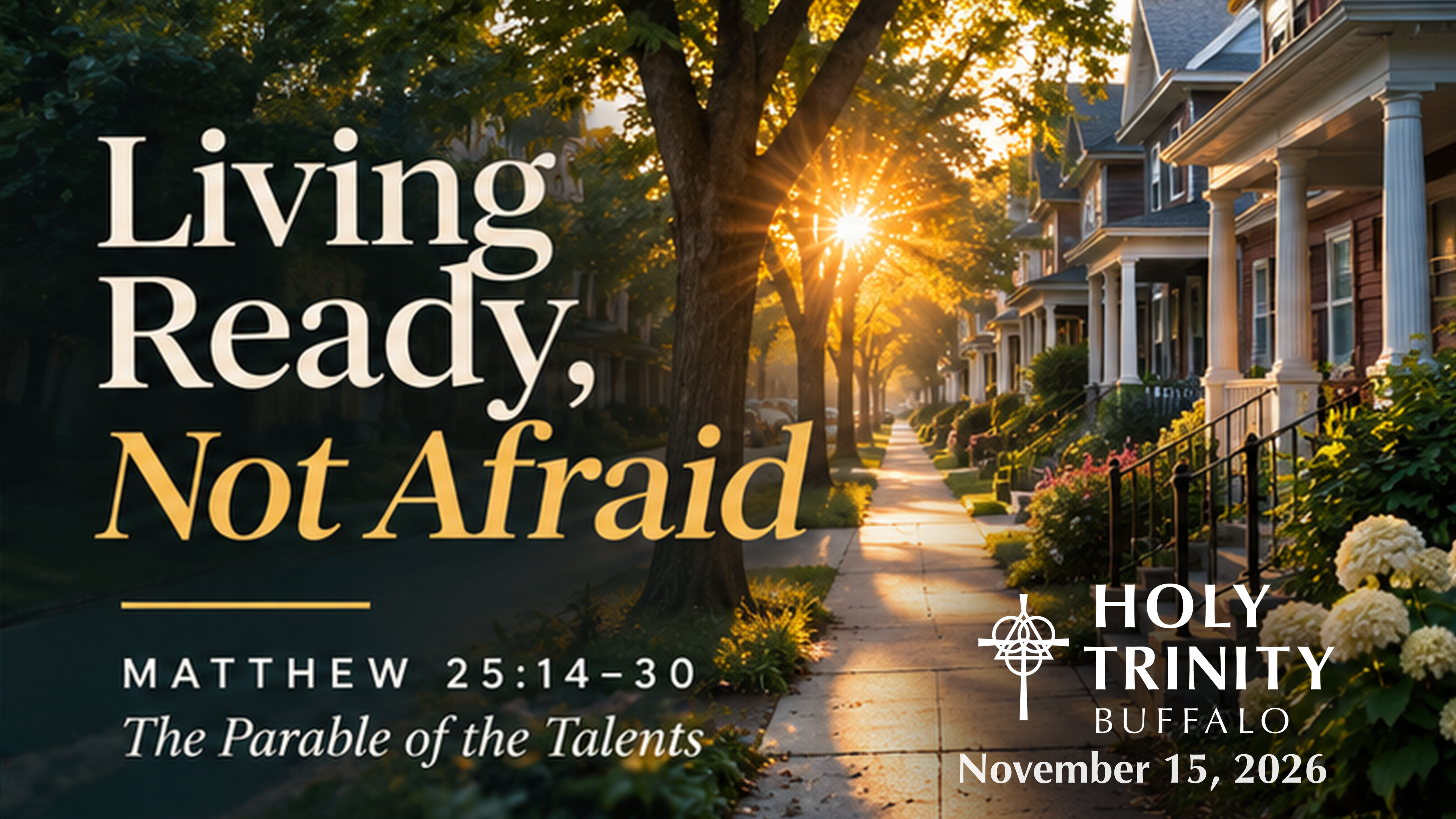
November 15, 2026 | 25th Sunday after Pentecost
Holy Trinity Lutheran Church — Buffalo, NY
References
Scripture: Matthew 25:14–30; with references to Matthew 22:37–39, Luke 10:25–37, John 10:10, 1 John 4:18, and Micah 6:8.
Video of worship/sermon
What Do We Really Know About Jesus’ Return?
How often in the normal course of our lives do we really think about Jesus’ return or Judgement Day?
Scriptures like what we heard today stir up thoughts and questions. And we try to understand what the Bible is saying as well as how our lives and our decisions make sense in light of the scriptures.
Isn’t it difficult for us to spend much time thinking about and trying to figure out something that really nobody knows much about.
There used to be considerable discussion, even argument, about whether someone was a premillennialist or a postmillennialist. But the thing is, there’s a lot we simply don’t know. Even people who have studied the Bible their whole lives recognize how much we don’t know about Jesus’ return.
So why even spend time thinking and talking about it?
Well, the Bible has enough to say, and enough stories to tell us about Jesus’ return, that we can’t simply ignore it.
Will Jesus’ return be glorious and joyful? Or will it be terrible and scary, as some of the scriptures, including our reading from Zephaniah, seem to suggest?
Is our experience of Jesus’ return based on whether we are good or bad? Whether we have enough faith? Whether we’ve done enough?
What Are We Supposed to Make of This Parable?
Jesus told a rather troubling parable about three slaves.
One slave was given five talents, another was given two, and the third was given only one.
But did you notice that none of them were given any instructions?
The rich traveler summoned the slaves, entrusted his property to them, and went away. He left no instructions, set no expectations, and gave no indication of when he would return.
The first two slaves, the ones who received five and two talents, doubled what they had been given.
Now, since we’re hearing about some rather small numbers—one, two, and five—I think the actual value entrusted to these slaves is greatly obscured.
Do you know how much a talent was worth?
Think about how much a laborer might earn in fifteen or twenty years.
That’s one talent!
Some estimates suggest that one talent might be worth something like $600,000 in today’s dollars. That’s just one talent! Think about two talents, or five. And then think about doubling those amounts.
We’re talking about a lot of money.
If I had $600,000 that I could give to you, can you imagine what it would take for you to double that? Much less $1.2 million, or several million dollars?
How would you even begin?
Would you have to do things that were illegal? Would you have to do things that were unethical?
Keep in mind that Jewish law prohibited charging interest to fellow Jews, with particular concern for those who were poor.
Yet the two slaves who doubled the money were praised, while the one who buried his talent in the ground was called wicked and lazy.
There’s certainly an argument to be made for understanding this parable as guidance for how you and I use the gifts God has given us to grow and expand the kingdom of God.
But I think this parable is about more than that.
Certainly more than money.
Is Jesus’ message that you and I should seek to grow the church or expand the kingdom of God by any means necessary? And that if we don’t, we’ll be considered wicked and lazy and be cast into the outer darkness, where there is weeping and gnashing of teeth?
Is that really how we’re supposed to envision Jesus’ return?
What If We’ve Been Watching the Wrong Slave?
As we explore this parable with a spirit of holy curiosity and holy wonder, perhaps there’s another way of looking at it.
Is Jesus’ message perhaps about noticing and challenging the systems around us?
Could this be a call from Jesus, who was very near his own death at the hands of two very powerful systems—the political and the religious?
Think about where everyone was at the end of the parable.
Because of the work of the slaves, the rich traveler was much richer.
But the slaves? They were still slaves.
There’s nothing in the parable that says they actually received any of the increase for their efforts.
Instead, the rich traveler told them that because they had managed his property so well, he would put them in charge of more.
Why? So that he could become even richer?
Perhaps it was the third slave, rather than the first two, that Jesus would have us focus on.
The one who received one talent.
The one who buried that talent in the ground.
The one who refused to participate in what the others were doing.
Wasn’t this the one who spoke truth?
He told the rich traveler that he know he was a harsh person, reaping where he did not sow and gathering where he did not scatter.
What if this parable invites us to think more deeply about the systems in which we live, and about what it means to participate in them—or to challenge them?
The Core of Our Faith Is Love
The core of our faith, the core of the Christian message, is not about being good enough, doing enough, having enough faith, or fitting into some mold of what we think a follower of Jesus should be.
Isn’t the core of our faith rooted in the Great Commandment?
When Jesus was asked which commandment was greatest, he answered that we are to love God with all our heart, mind, soul, and strength.
And the second is like it: Love your neighbor as yourself.
A good barometer for our lives is simply to look at our relationships with the people we know, and even with strangers with the Parable of the Good Samaritan in mind.
Jesus asked who was a neighbor to the man who had been beaten, robbed, and left for dead?
Was it the priest? Was it the Levite? Or was it the Samaritan?
If the core of Jesus’ message is love, then we live as good neighbors.
We’re in a perfect place for that, because Buffalo is the “City of Good Neighbors!”
And we’re called to be good neighbors even to people we don’t know.
Even to people we don’t like.
Even Patriots fans!
And Eagles fans!
We are called to advocate for our neighbors … to protect the poor and the vulnerable … to use our voices on behalf of others … to seek justice.
Just to be clear … we’re not talking about tiny justice … justice that moves at the speed of a trickle as if a spigot has only been opened slightly to release the water held behind it.
We’re not talking about tiny justice, but huge and powerful transformative justice! … a justice so abundant and swift … a justice like that proclaimed by Martin Luther King Jr. proclaimed drawing on the words of the prophet Amos:
“Let justice roll down like waters and righteousness like a mighty stream.”
This isn’t about doing enough to earn God’s love or our salvation. God’s grace isn’t something we earn through our efforts.
Rather, these are ways of living as followers of Jesus, responding to the love and grace we have already received.
Living Ready, Not Afraid
Jesus comes to you and me—to all of us—every day.
Should we be afraid when Jesus comes to us?
Should we worry about whether we’ve done enough, whether we have enough faith, whether we’re good enough?
Jesus said that he did not come like the thief who comes to steal, kill, and destroy. Rather, he came so that we might have life, and have it abundantly (John 10:10).
So how about living in readiness?
Rather than living in fear and uncertainty, how about simply setting ourselves to the work of the kingdom of God?
How about being a good neighbor to the people around us by:
- Doing justice.
- Loving mercy.
- Walking humbly with our God.
As we live in this way, we are living ready.
We’re not living with a focus on Jesus’ return in some uncertain future.
We’re not living in fear and uncertainty.
We’re living in the hope and assurance that Jesus comes to us every day.
And in that way, we live out the words that Jesus taught us:
Thy kingdom come.
Thy will be done,
on earth as it is in heaven.
In the name of Jesus. Amen!
Questions for Reflection
- How might our understanding of the Parable of the Talents change if we pay more attention to the third slave and the systems he challenges?
- Where do we see systems in our own communities that benefit some people while leaving others vulnerable or excluded? What might it mean to respond with love and justice?
- What would change in our lives if we thought of living ready for Jesus not as preparing for something to fear, but as being a good neighbor and living in God’s love every day?

Leave a Reply