
November 22, 2026 | 26th Sunday after Pentecost
Christ the King Sunday
Holy Trinity Lutheran Church — Buffalo, NY
References
Scripture · Matthew 25:31–46 · Luke 10:25–37 · Matthew 20:28 · Mark 10:45
Video of worship/sermon
Who is Jesus in our lives today?
What kind of leader would you be willing to follow?
What do you look for in a leader? What kind of character? What values? What is important to them?
In 1925, Pope Pius XI was troubled by increasing secularism and nationalism. People around the world were following leaders and embracing values that were at odds with the Kingdom of God.
He wanted people to have a time to focus on Jesus’ leadership … Jesus’ kingship … and, therefore, the values of the Kingdom of God. What does it mean for how we live? How we participate in public life? What we do outside this congregation?
So the pope instituted Christ the King Sunday, which comes at the very end of the liturgical year.
Over the past year, we’ve heard stories of people looking forward to the Messiah, the chosen one whom God would send into the world. We’ve heard stories of people seeking healing and wholeness, struggling with faith, and worrying about family and friends.
We’ve heard how Jesus angered and frustrated people … how he confused them. We’ve also heard how he met people where they were and brought healing and restoration.
So, in the spirit of Christ the King Sunday, who is Jesus in your life today?
What values do you see alive in Jesus’ kingdom?
Wherever God’s influence is
Talking about kingdoms can easily take us into the realm of politics. Whatever our political affiliations or wherever we live, the questions are still the same. Who is Jesus for us today? What does it look like to live by the values of Jesus’ kingdom?
I think it can be helpful to have short definitions for big ideas. Volumes have been written about the Kingdom of God, but here’s a way to think about it.
A kingdom is wherever the influence of the king or queen is. Their influence, whether good or bad, extends beyond the castle walls, out into the villages and the land around them. It might extend all the way to where it meets the influence of another kingdom.
So, the Kingdom of God is wherever God’s influence is.
It’s wherever God’s values are lived.
What counts as enough?
Fair enough. But then Jesus compares himself to a king who “separates people one from another as a shepherd separates the sheep from the goats.” We might wonder how that fits with the Jesus we’ve come to know.
Look at the criteria Jesus uses. How did people treat those who were hungry or thirsty? How did they treat the stranger, those who needed clothing, those who were sick, and those who were imprisoned?
These words can cause us to worry about whether we are sheep or goats. Have we done enough for people who are poor or marginalized? What counts as enough? If there’s a scale, is there one notch where we suddenly become good enough? And what if we didn’t help people earlier in our lives, but we’re doing it now?
See how quickly that turns our eyes back onto ourselves?
This is when we need to remember one of the foundational values of the Kingdom of God … grace.
We’re saved by grace. When we get caught up in evaluating whether we’ve helped enough people, we take our eyes off Jesus as our savior. I think Jesus is drawing our attention to the people around us and to the importance of caring for them. This is what the values of God’s kingdom look like in practice.
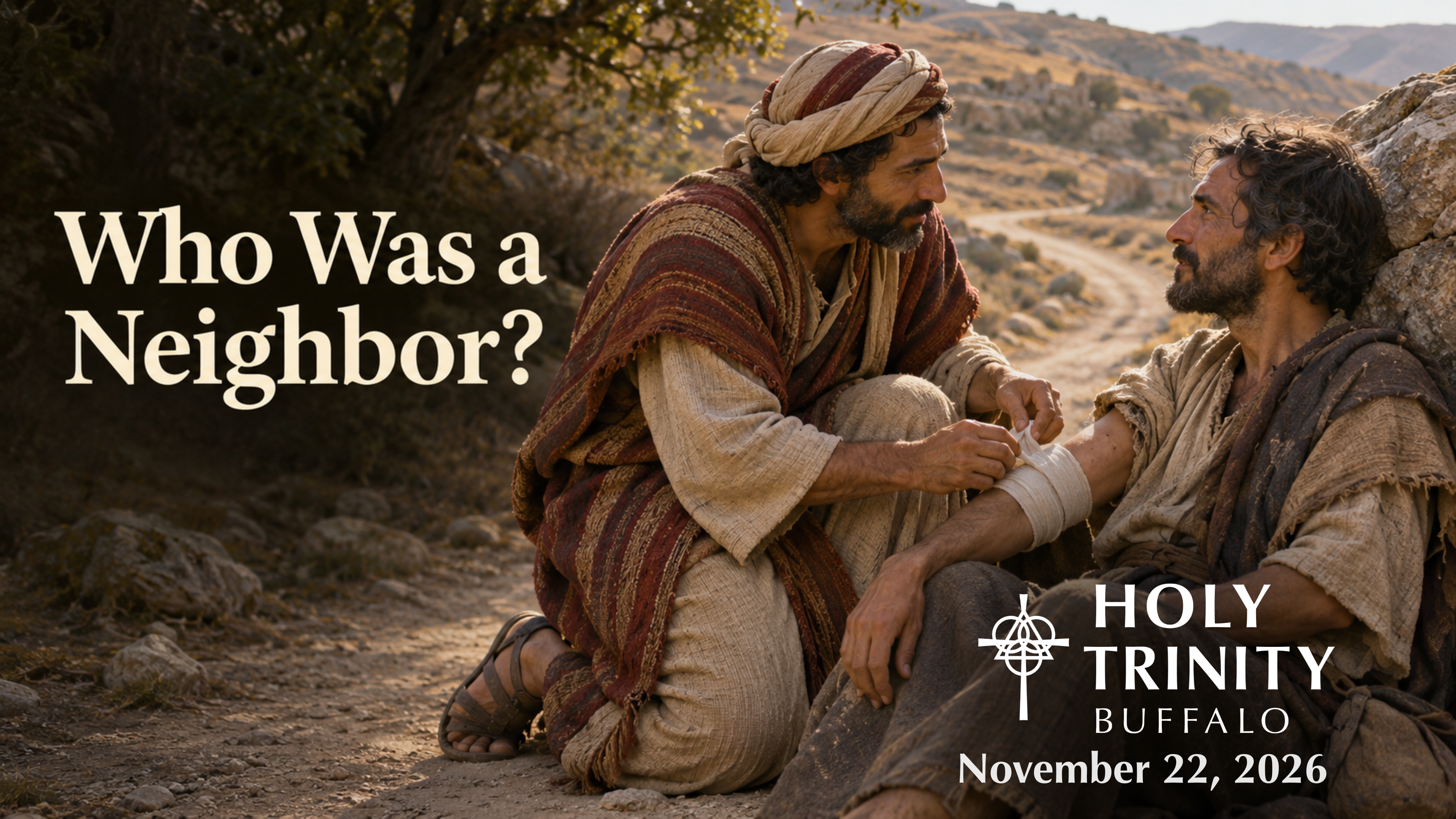
Who was a neighbor?
In Luke’s Gospel, a lawyer asked Jesus what he must do to inherit eternal life. Jesus responded by asking him question: “You know the law; what do you find there?”
The lawyer answered from the Scriptures: Love God with all you are, and love your neighbor as yourself.
Then he asked Jesus, “And who is my neighbor?”
Jesus told him what we know as the Parable of the Good Samaritan. A man was hurt and left by the side of the road. The priest and the Levite passed by. The Samaritan – the unlikely one – stopped and helped.
Where the lawyer asked Jesus, “Who is my neighbor?” Jesus asked, “Who was a neighbor to the man?”
Do you hear the difference?
We can have neighbors and still have to ask ourselves whether we’re being neighborly.
Would you be my neighbor?
You and I follow Jesus, who identifies with people who are poor and marginalized … who comes to serve rather than to be served.
This is the kind of king and kingdom Jesus invites us into.
Next Sunday is the first Sunday in Advent. Advent is a time of new beginnings. As part of that new beginning at Holy Trinity, we’ll begin a year-long focus on neighborliness with the invitation, “Would you be my neighbor?”
You might hear an echo of Fred Rogers and his “Won’t you be my neighbor?” I kind of like “Would you be my neighbor?”
This is Jesus. This is the king you and I are invited to follow.
And we’re invited to be a neighbor. To make a difference in the lives of other people. To be the hands, the feet, the voice, and the heart of Jesus in our world.
For reflection
- What do you look for in a leader? How does Jesus’ way of serving shape what you look for?
- When you catch yourself wondering whether you’ve done enough, how might God’s grace change where you put your attention?
- Who has been a neighbor to you? What might it look like to be a neighbor to someone else this week?

Leave a Reply